Explore Projects Big Bang Atlas

Big Bang Atlas

How do we model the universe? How do the numbers we use relate to real spacetime? And what can cosmology tell us about time? A joint exploration by Souvik Ghosh and Prof. Prosenjit Singha Deo.

  • StatusExploration, early stage
  • TeamSouvik Ghosh and Prof. P. Singha Deo
  • So farTwo working sketches and two prototype notebooks

The picture we start from

Space itself grows.

Galaxies do not fly outward through space. They stay where they are, and the space between them stretches. Press play, or drag the time.

This is textbook cosmology drawn live: a flat universe with matter and dark energy (Hubble constant 67.4 km/s/Mpc, matter fraction 0.315, radiation left out). It is the standard model the project starts from, not a result of ours.

Time since the big bang
13.8 billion years
Size compared with today
1.00
Redshift
0.00
Hubble radius
14.5 billion light years
You are the ring at the centre. Gold points are being carried away faster than light; the dashed ring is the Hubble radius; the faint outer ring is the edge of today’s observable universe, about 47 billion light years away in this model. Illustration, not a simulation of ours.

Two aims

Build the picture. Question the language.

The first aim

A picture driven by the formulas.

Build an interactive visualisation of cosmic expansion where every frame comes from the equations, so the model can be seen, questioned and changed.

The second aim

What are we assuming?

Examine the cosmic microwave background as a special reference frame, the relation between coordinate time and proper time, and the assumptions that enter when spacetime is described with real numbers.

The questions

What we are asking.

Labels or reality

Where do the numbers end and the physics begin?

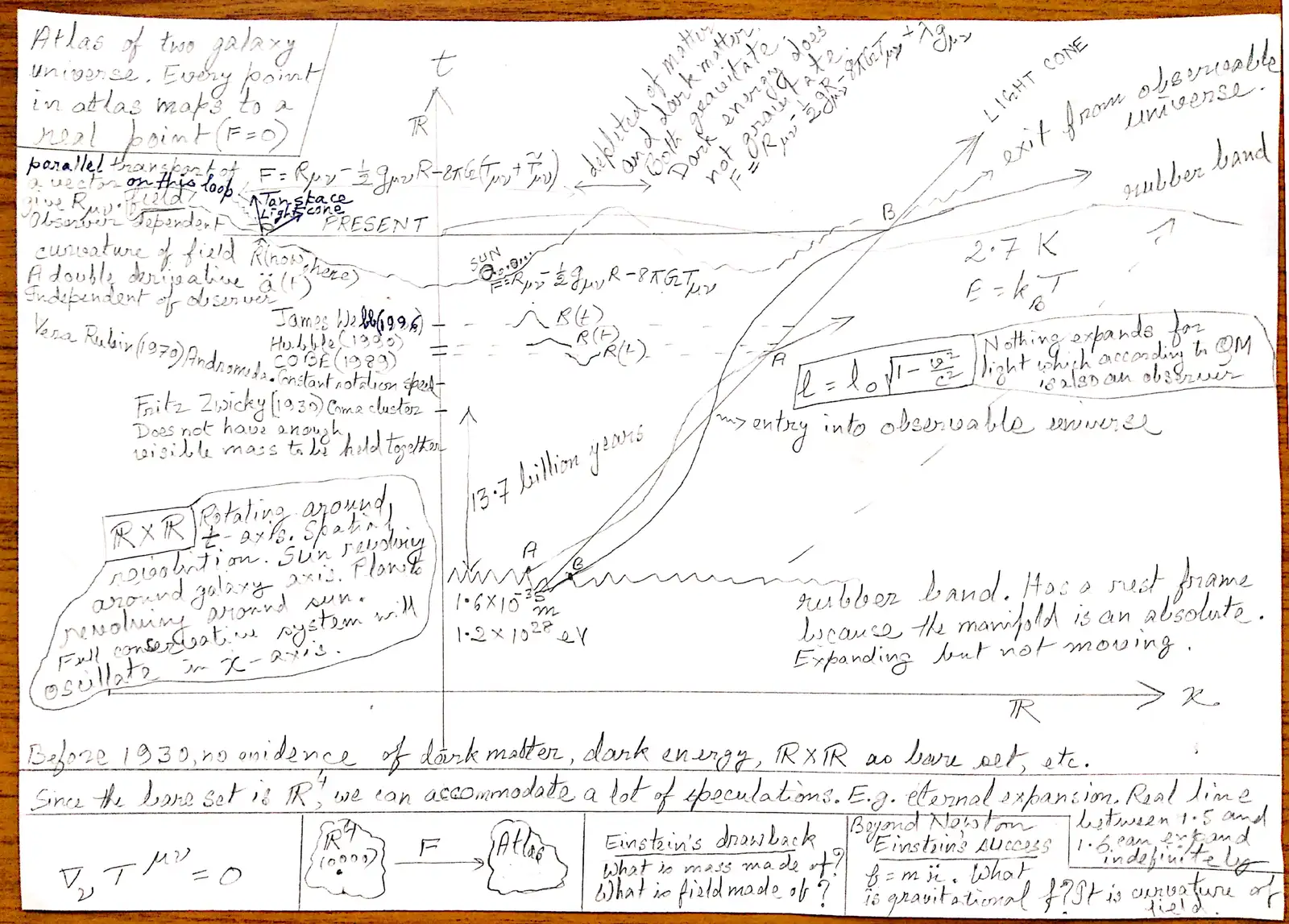
Points of spacetime are labelled with real numbers; physics is the structure laid on top of the labels. The first sketch draws this as a map from R4 to an atlas. What that map is, exactly, is still to be defined.

A cosmic clock

Can the afterglow of the big bang define a time?

The cosmic microwave background picks out a preferred frame of rest. The long-term goal is to ask whether it can anchor a time for the whole universe. A preferred frame is not the same as an absolute one, and we have not yet settled what “absolute time” should mean.

Extrapolation

How far can a century of observation reach?

A short history of astronomy supports a reconstruction 13.8 billion years long. We ask what must hold for that to be safe, and what a small observed stretch of a curve could hide.

Lab time and cosmic time

Does the time of an electron meet the time of the universe?

In our mesoscopic work, the time of the reservoirs is contrasted with the proper time of the electron crossing a sample. Whether that connects to cosmological time is an open question. There is no derivation yet.

See the time research

Where it stands

An exploration, in progress.

We are building the picture first and claim no new prediction yet. Dark matter, dark energy and the early history of the universe are questioned in our discussions. They are not disproved by them.

Done so far

  • Two handwritten models and a four-slide outline.
  • A prototype notebook: scale factor, a conformal spacetime diagram, last scattering, the past light cone and the Hubble radius.
  • A prototype notebook: galaxies at fixed positions moving apart as space expands.

Still to decide

  • What “Atlas” and the map F mean mathematically.
  • An operational definition of the time we are after.
  • Which equations, parameters and observations constrain the simulation.
  • What the bell-shaped curve in the sketch stands for: a scale-factor history, a distance envelope or a conformal diagram.

From the notebook

The two working sketches.

A handwritten page: a time axis and a space axis, a curved expansion envelope, light cones, a wavy line labelled rubber band for the cosmic microwave background, and notes on dark matter, dark energy and an atlas of points.
The first sketch. A page of questions, not conclusions. Several statements on it are still being checked.
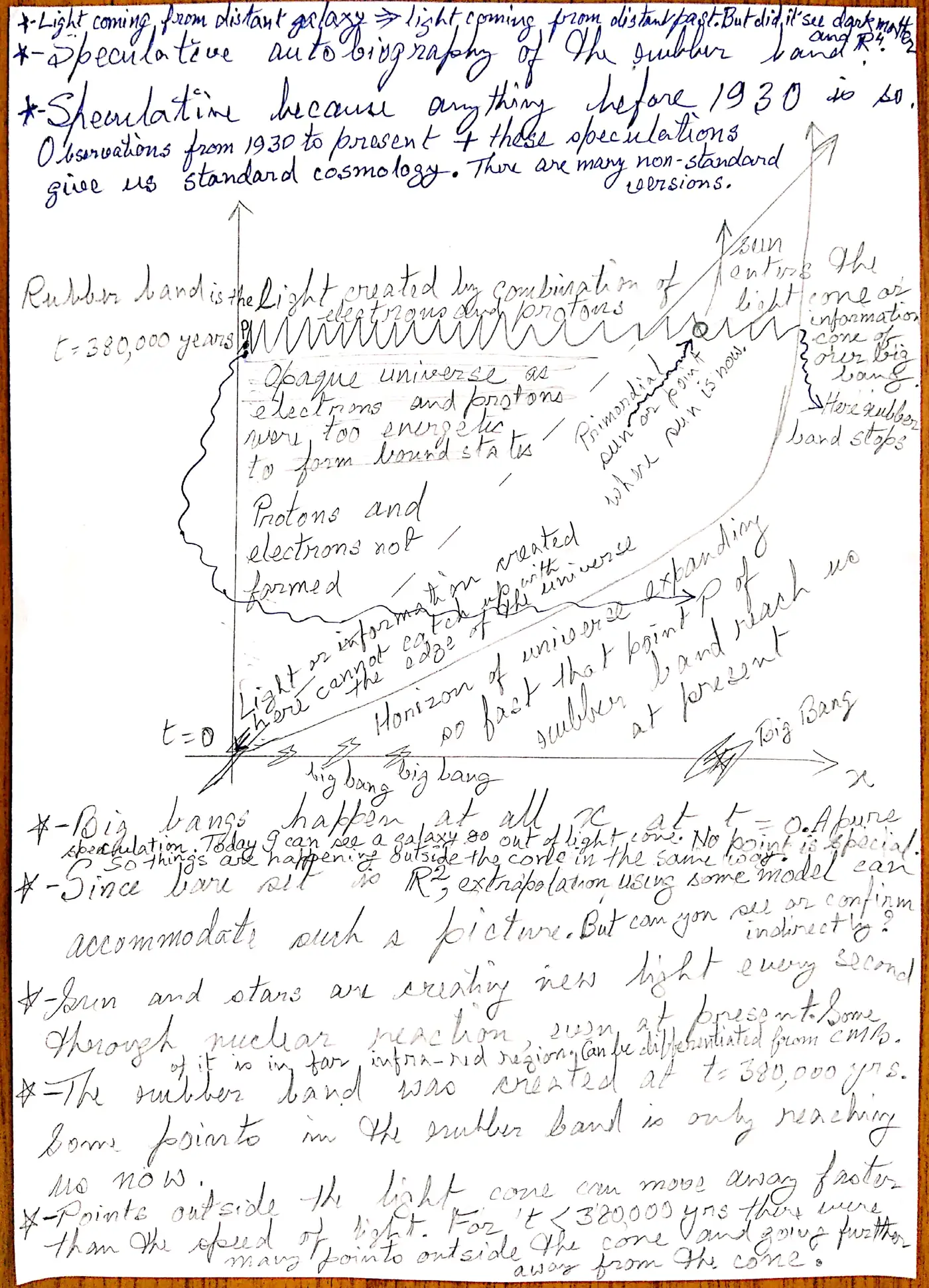
A second handwritten page: a time axis and a space axis, a wavy line at 380,000 years labelled rubber band, an opaque early universe below it, a horizon line, and notes headed speculative autobiography of the rubber band.
The second sketch, which its own heading calls speculative: the history of the “rubber band”, the light released 380,000 years after the big bang.

Reading

Where to check us.

  1. Paper · 2003Expanding Confusion: common misconceptions of cosmological horizons and the superluminal expansion of the UniverseT. M. Davis & C. H. LineweaverarXiv:astro-ph/0310808. The reference for horizons and the Hubble sphere.
  2. Paper · 2020Mathematical languages shape our understanding of time in physicsN. GisinarXiv:2002.01653. A comparison for the question of real numbers and time, not a proof of anything here.
  3. Preprint · 2025Reinterpreting Landauer conductance, solving the quantum measurement problem, grand unificationKanchan Meena, Souvik Ghosh & P. Singha DeoarXiv:2512.09709. The mesoscopic-time work this project connects to. Its claims are the authors’ own and remain open to scrutiny.